

Bird Crime continues to be a significant issue in North Yorkshire but the situation is getting better.
North Yorkshire Police say the RSPB's annual bird crime survey shows the county is no longer the worst place for Bird persecution in the UK.
Chief Inspector Alex Butterfield works on specialist operations for the force.
All birds of prey are protected by law under the Wildlife and Countryside Act 1981. The RSPB says that in 2021 there were 80 confirmed incidents in England, making it the second-worst year on record.
Two of the worst counties based on 2021 data – Norfolk (13 incidents) and Dorset (12 incidents) – are lowland areas, dominated by pheasant and partridge shooting. The third worst county was North Yorkshire (10 incidents), which includes grouse, pheasant and partridge shooting.
Mark Thomas, RSPB head of investigations UK, said:
“The data clearly show that raptor persecution remains at a sustained high level, especially in England, with over two thirds of the incidents connected to land managed for gamebird shooting.
“The illegal shooting, trapping and poisoning of birds of prey has no place in modern society. In a nature and climate emergency, the deliberate destruction of protected species for financial gain is completely devastating and unacceptable.
“The time for reform is now long overdue. Licensing driven grouse moors is the first step in clamping down on those estates engaged in criminal activity at no loss to those operating within the law.”
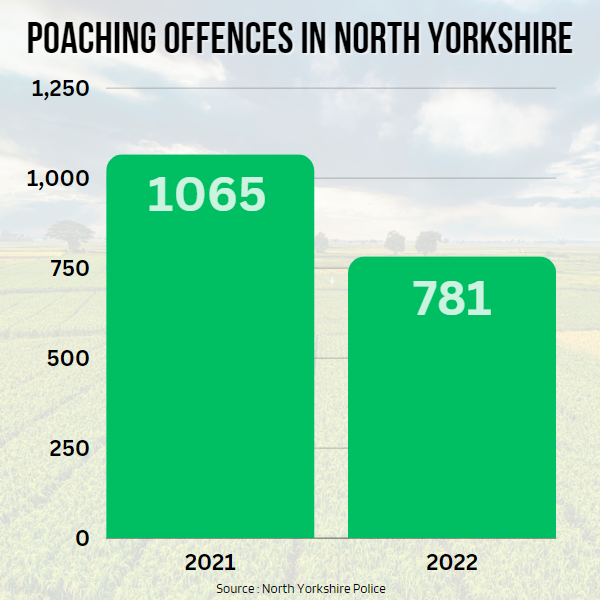
As well as the improving position with bird persecution the North Yorkshire force says it has also seen a reduction in poaching offences with a 26 percent drop in poaching over the last year.
Chief Inspector Alex Butterfield says the force is tacking a number of rural crime types and says bird crime is particularly difficult.
A recent report by the North Yorkshire Police and Crime Commissioner illustrated the actions being taken by North Yorkshire Police to tackle rural crime.
It says that to improve the use of sanctions against offenders, North Yorkshire Police was among several forces taking “a creative approach to the use of alternative legislation such as anti-social behaviour legislation”.
Over the past two years, the force has utilised problem-solving oriented responses to tackle poaching, such as Criminal Prevention Warnings and Criminal Prevention Notices to track the behaviour of offenders.
Chief constable Lisa Winward said rather than having to prove each individual offence, Criminal Behaviour Orders meant the force could take action when someone breached a described behaviour.
She said:
“It broadens the opportunity to tackle the criminality of that person where walking down a track or being with a dog is not an offence in itself, but if you put them on an order that says they can’t do that thing you then criminalise that behaviour.”
The report also highlights that North Yorkshire Police is taking the persecution of birds of prey seriously, recording every incident where other forces did not.

 Solar Panels Confirmed For Whitby And Eastfield Public Buildings To Cut Energy Bills
 Scarborough HMO Growth Sparks Fresh Tourism Concerns
 BLOWN OFF COURSE: Late Penalty Spoils Boro’s Comeback Hopes
 Giantkilling Bridlington Town's Trophy Triumph
 Whitby Town Lose Out In Six-Goal Thriller
 Scarborough Rugby Edge Thriller On Busy Afternoon
 52 New Homes Approved in Sherburn Despite GP Surgery Capacity Warning
 Scarborough's Kingfishers Celebrate West Yorkshire Success
 Pickering Town Punished By Visitors
 Scarborough Dealer Jailed
 Over 500 Homes In Scarborough And Whitby To Receive Energy Efficiency Upgrades
 FLOOD WARNINGS Issued For Scarborough's Foreshore Road & Sandside













Comments
Add a comment