


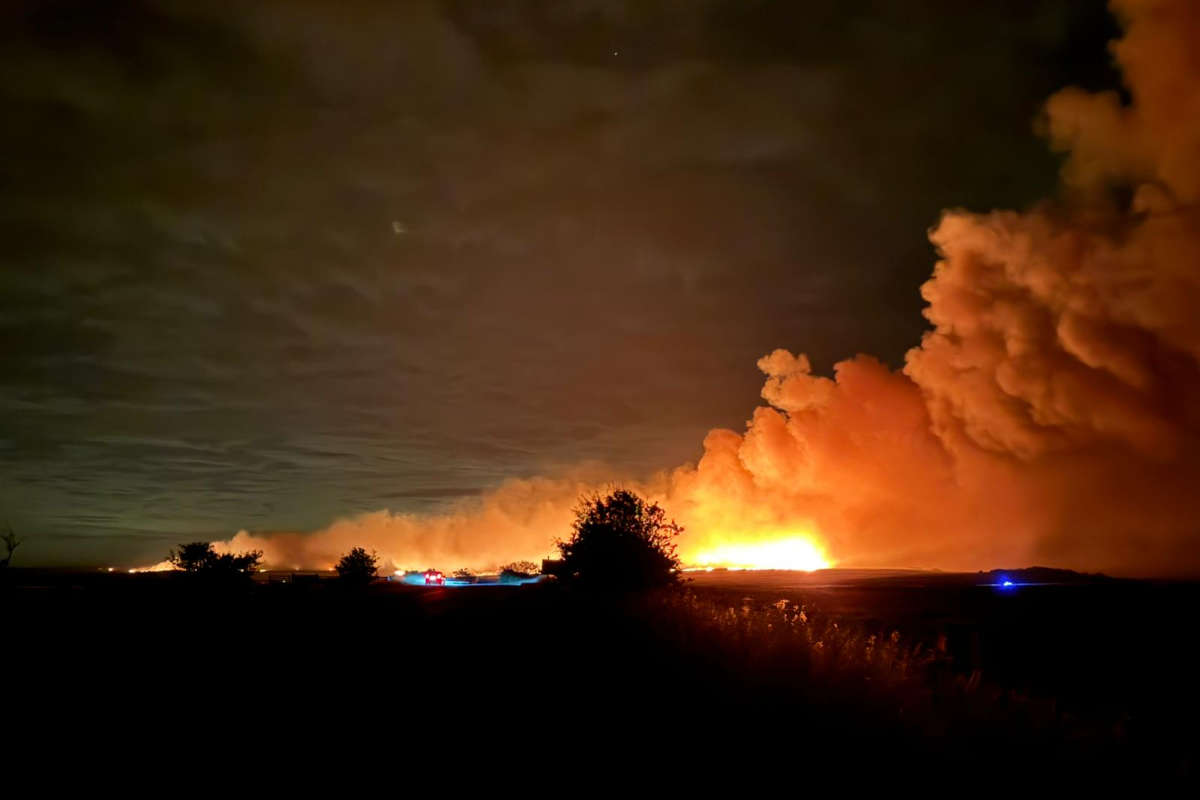
The North Yorkshire Fire and Rescue Service is set to invest in its own drone technology and satellite communications to better tackle remote wildfires following a major incident debrief into last summer's Fylingdales Moor blaze.
The North Yorkshire Fire and Rescue Service is to establish its own dedicated drone capability and upgrade its communications infrastructure following an in-depth debrief into last summer's major wildfire on Fylingdales Moor.
The blaze, which broke out in the summer of 2025, was the largest wildfire in the recorded history of the North York Moors National Park. At its peak, the fire boundary covered approximately twenty square kilometres, causing significant disruption to the Yorkshire Coast. The incident forced the closure of the A171 coastal route between Scarborough and Whitby, while a strategic holding area for national resilience assets was established at the Pickering showground.
A major multi-agency debrief into the incident has highlighted the critical role that technology played in managing the response. Responders faced immense challenges operating in remote, hazardous terrain with poor network connectivity. Furthermore, the incident ground was littered with unexploded military ordnance from the site's history as a military training range, which restricted ground access for crews and necessitated a defensive firefighting strategy.
According to the official reports, the use of drones was identified as a notable strength of the emergency response. Drones provided persistent aerial situational awareness and heat mapping without the risks, costs, and access constraints associated with crewed helicopters. Crucially, they allowed for intelligence gathering in areas where the unexploded ordnance made it too dangerous to deploy firefighters on foot.
The debrief advised the service to formalise and expand its assured drone capability specifically for wildfire response and investigations. Historically, the service has relied on mutual aid arrangements to access this technology.
Chief Fire Officer Jonathan Dyson said:
"I don't think any chief fire officer would think that they would be in a position where they haven't to contract with helicopters. Nonetheless, that's position we found ourselves in.
The service has had agreements in place with both police and with other fire rescue services for drone provision, where this was a challenge was of course, because police then started to need to utilize theirs, as did other services, and it's been a funding challenge in the past for us to maintain this provision.
Nonetheless, we have the commitment from myself and the mayor that we are exploring this now. The service will move to a self-provision of drone capability,"
Alongside aerial technology, the incident exposed severe limitations in standard communications. The reports noted that the incident ground suffered from poor mobile phone and Wi-Fi coverage, which initially hindered situational awareness. To overcome this, satellite systems like Starlink were required to provide reliable internet connectivity where conventional networks failed.
The debrief recommended the adoption of satellite-based systems as a standard for future remote incidents, as well as the digital modernisation of shared mapping and electronic risk assessments through platforms such as Microsoft Teams.
Chief Fire Officer Dyson confirmed that the service is already taking action on these recommendations to secure robust communications for the future.
"We're exploring and we have demonstrations next month actually on the moor itself because the service had to utilize Starlink through local arrangements for us to actually have incident communications in these super remote rural areas.
So we're not only strengthening our technology position, we're strengthening the incident command, the radiocoms, everything around here. So we are already well underway with this recommendation."
By moving to a self-provision model for drones and embedding satellite connectivity, the North Yorkshire Fire and Rescue Service aims to ensure that commanders have real-time access to vital information, ultimately improving the safety and efficiency of responses to future large-scale emergencies.

 Nine Minutes from Glory: Heartbreak for Boro as Macclesfield Snatch Late Replay
 East Riding Mum Ventures Change To System After Second Term Time Holiday Fine
 North Yorkshire Faces Major Challenge to Prepare Local Plan in 30 Months
 Pre-Halloween Spooktacular Will Raise Vital Funds For Scarborough Hospice
 Did You See East Riding Bridge Colission?
 Scarborough Foster Couple To Run New Support Hub For Vulnerable Children
 Bridlington Town Back To Winning Ways
 Yorkshire Coast Rugby Round Up
 Pickering Town Back Into Top Ten With Victory
 Record Numbers Of Young People Explore Future Careers At East Yorkshire Apprenticeship Expo
 Historic Sleights Pub Set To Reopen Under New Local Ownership
 Patients Could Opt Out of Care Over NHS Data Platform Fears, Councillors Warned