

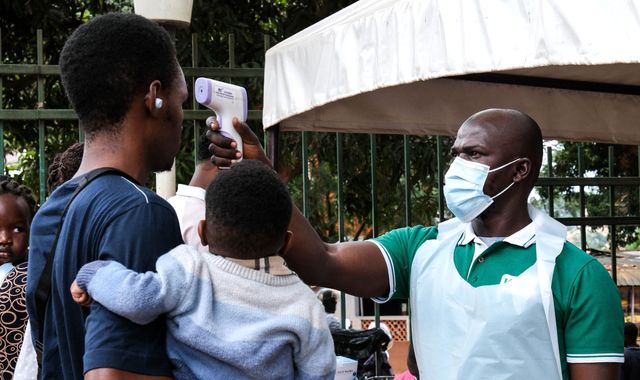
The World Health Organisation (WHO) has declared an Ebola outbreak in the Democratic Republic of Congo and Uganda a "public health emergency of international concern".
The WHO said 80 suspected deaths, eight laboratory-confirmed cases and 246 suspected Ebola cases had been reported as of Saturday in DRC's remote Ituri province across at least three health zones, including Bunia, Rwampara and Mongbwalu.
Africa Centres for Disease Control and Prevention (Africa CDC) said on Saturday at least 87 people had died in the eastern province, with 336 suspected and 13 confirmed cases recorded. Four people have died among the confirmed cases.
In Uganda's capital, Kampala, two apparently unrelated laboratory-confirmed cases, including one death, were reported on Friday and Saturday, from people travelling from the DRC, the WHO said.
The Ugandan health ministry said the cases were "imported" from the DRC and the body of the patient who died in Kampala was later taken back to the DRC.
A laboratory-confirmed case was also reported in the DRC capital, Kinshasa, from a person returning from Ituri, the United Nations health agency added.
The WHO said the outbreak does not meet the criteria of a pandemic emergency.
Africa CDC has raised concerns about the risk of further spread of the disease due to the proximity of affected areas to neighbouring Uganda and South Sudan.
The agency also warned of an "active community transmission" as health workers raced to intensify screening and contact tracing to contain the disease.
Difficulty tracking cases
Africa CDC director-general Dr Jean Kaseya said the first cases were reported in Mongwalu health zone, a high-traffic mining area, before migrating to the Rwampara and Bunia "as patients sought medical care, enabling spread across three health zones".
Of the 87 deaths, 57 are in the Mongwalu health zone, 27 in the Rwampara health zone and three in Bunia, Ituri's main city.
Mr Kaseya said a large number of active cases remain within Mongwalu in particular, "significantly complicating containment and contact tracing efforts".
Ongoing attacks by Islamic State-backed militants are also restricting surveillance and rapid response operations in Ituri, he added.
Congolese Health Minister Samuel-Roger Kamba said late Friday the suspected index case in the current outbreak is a nurse who died at a hospital in Bunia.
Mr Kamba said the case dates back to 24 April. He said the nurse presented with symptoms suggestive of Ebola, but he did not say whether samples from them were tested.
DRC has experienced 17 Ebola outbreaks since the disease was first identified in the country in 1976.
Read more from Sky News:
Man dies after shark attack in Australia
Train hits bus in Thailand - eight dead
One of the deadliest outbreaks, between 2018 and 2020 in eastern Congo, killed more than 2,000 people.
The country's eastern regions are also facing ongoing violence involving armed groups, including the M23 rebel movement and the Islamic State-linked Allied Democratic Force, complicating efforts to contain the disease.
Dr Gabriel Nsakala, a public health professor involved in previous Ebola responses in DRC, said the country had extensive experience dealing with outbreaks but warned rapid action would be essential.
"In terms of training, people already know what they can do," he said. "Now, the expertise and equipment need to be delivered quickly."

(c) Sky News 2026: WHO declares global public health emergency over Ebola outbreak in Democratic Republic of Congo and Uganda

 'Everyone is doing it': The dark art of GPS jamming in the Iran war
 Maldives suspends search for four Italians in underwater cave after military diver dies
 Eight injured after car ploughs into pedestrians in Italy
 Freight train hits bus in Thailand - at least eight dead
 Man dies after second fatal shark attack in Australia
 Trump says freeing activist Jimmy Lai jailed in China is 'tough'
 CIA chief visits Cuba as US demands 'fundamental changes'