
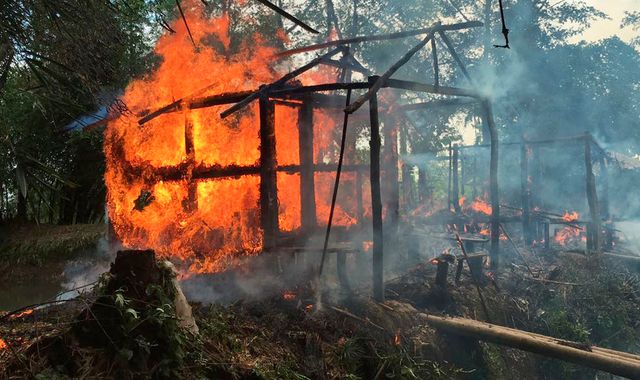
When Dr Ronan Lee spoke to members of the Rohingya community, he heard "blood-curdling accounts" of killings and sexual violence allegedly carried out by Myanmar's security forces.
They described how hundreds of villages were burned to the ground, with Myanmar's military treating Rohingya males "as fair game for extermination", the author and academic said.
Thousands of people were killed and a "monstrous campaign of sexual violence" was unleashed against women and girls from the mainly-Muslim minority group, alleged victims told Dr Lee.
Now their stories are being heard directly in an international court for the first time in a landmark case, where Myanmar stands accused of committing genocide.
More than 700,000 Rohingya refugees fled the Southeast Asian country into neighbouring Bangladesh during the 2017 military crackdown.
Myanmar, which says it launched the campaign after an attack by a Rohingya insurgent group, has denied allegations of genocide.
The long-awaited International Court of Justice (ICJ) hearings began last week in The Hague, and the case is expected to set precedents about how a genocide can be defined and proven.
It was first filed by the Gambia, which has argued that Myanmar's military engaged in a "clearance operation" that violated the 1948 Genocide Convention.
The Gambia's justice minister, Dawda Jallow, said his country had brought the case out of "a sense of responsibility" following its own experience with a military government.
At the opening of the case last week, Mr Jallow told the court the Rohingya people had "endured decades of appalling persecution, and years of dehumanising propaganda".
"They have been targeted for destruction," he said.
"Myanmar has denied them their dream - in fact, it turned their lives into a nightmare, subjecting them to the most horrific violence and destruction one could imagine."
What has Myanmar said?
Myanmar, which has been under military control since 2021, opened its defence in the case, with representative Ko Ko Hlaing telling the court the country was "not obliged to remain idle and allow terrorists to have free rein of northern Rakhine State".
He added the case will be decided "on the basis of proven facts, not unsubstantiated allegations" and "emotional anguish and blurry factual pictures are not a substitute for rigorous presentation of facts".
Who are the Rohingya?
More than a million Rohingya people lived in Myanmar at the start of 2017, with the majority in Rakhine State in the west of the country.
With their own language and culture, they say they are descendants of Muslim traders who have lived in the region for generations.
But Myanmar, a predominantly Buddhist country, has long considered the Rohingya people to be illegal immigrants from neighbouring Bangladesh and denied them citizenship.
Following the 2017 crackdown, more than a million Rohingya people are now in chaotic, overcrowded camps in Bangladesh.
A UN fact-finding mission concluded the military offensive had included "genocidal acts". Myanmar authorities rejected that report, saying the military offensive was a legitimate counter-terrorism campaign.
Role of Facebook
Over three weeks of hearings, the ICJ will hear from alleged victims in closed sessions - the first time their accounts have been told directly in an international court.
The case also breaks new ground by exploring the use of Facebook as the main media for allegedly distributing hate speech.
Dr Lee, whose research focuses on Myanmar, the Rohingya, genocide and hate speech, says Facebook became a key platform in the spread of anti-Muslim and anti-Rohingya messages at that time.
"Facebook was virtually unregulated within Myanmar at that time and allowed anti-Rohingya posts to proliferate on its platform," the Loughborough University expert says.
"This provided the political cover and public support to enable the Myanmar military to undertake its 2017 violence against Rohingya without any meaningful public backlash or opposition from influential political figures."
Sky News has approached Facebook for comment.
What's the likely outcome at the ICJ?
In the case against Myanmar, Dr Lee believes the Gambia has a chance of success.
"The evidence strongly indicates Myanmar's military undertook violent actions targeting Rohingya civilians because they were Rohingya," he adds.
"And the decades-long mistreatment of Rohingya by Myanmar's military and government strongly indicates a desire to destroy the Rohingya as a Myanmar community."
The trial is the first genocide case the ICJ has taken up in full in more than a decade, and its outcome could have repercussions for how future allegations are assessed, including South Africa's case accusing Israel of genocide in Gaza.
Several members of the Rohingya have made the trip to the Netherlands to attend the hearings, which are expected to last three weeks.
A final ruling is expected towards the end of 2026.
Read more:
Explained: The 2017 Rohingya refugee crisis
Myanmar holds election - but critics call it a 'sham' vote
Myanmar was initially represented at the court by Nobel Peace Prize winner Aung San Suu Kyi, who denied her country's armed forces committed genocide, telling the ICJ in 2019 that the mass exodus of Rohingya people from the country she led was the unfortunate result of a battle with insurgents.
She is now in prison after being convicted of what her supporters call trumped-up charges after a military takeover of power.
A finding of genocide may also have an impact on the ongoing investigation at another court based in The Hague, the International Criminal Court.
In 2024, the court's chief prosecutor asked judges to issue an arrest warrant for the head of Myanmar's military regime, Senior General Min Aung Hlaing, for crimes against the Rohingya.
Gen Hlaing has previously denied the allegations, and the request for the warrant is still pending.

(c) Sky News 2026: 'Blood-curdling accounts' of killings and sexual violence: What we know about landm

 Iran warns any attack will mean 'all-out war' after Trump says US 'armada' on its way
 'Sacrifices deserve respect': Prince Harry joins PM in criticising Trump's NATO troops remark
 Ukraine hits out at Winter Paralympics for lifting ban on Russia
 Swiss bar co-owner released on bail as investigation into deadly fire continues
 How close is a peace deal in Ukraine - and have we been here before?
 Stars of fashion and film say farewell to Italy's haute couture 'emperor' Valentino
 I was in Helmand with UK troops. Draft 'dodger' Trump's words are a gut punch to families of those killed
 Ryan Wedding: Former Olympic snowboarder linked to alleged drug trafficking and murder arrested
 British troops were in Afghanistan from start to finish - despite what Trump says