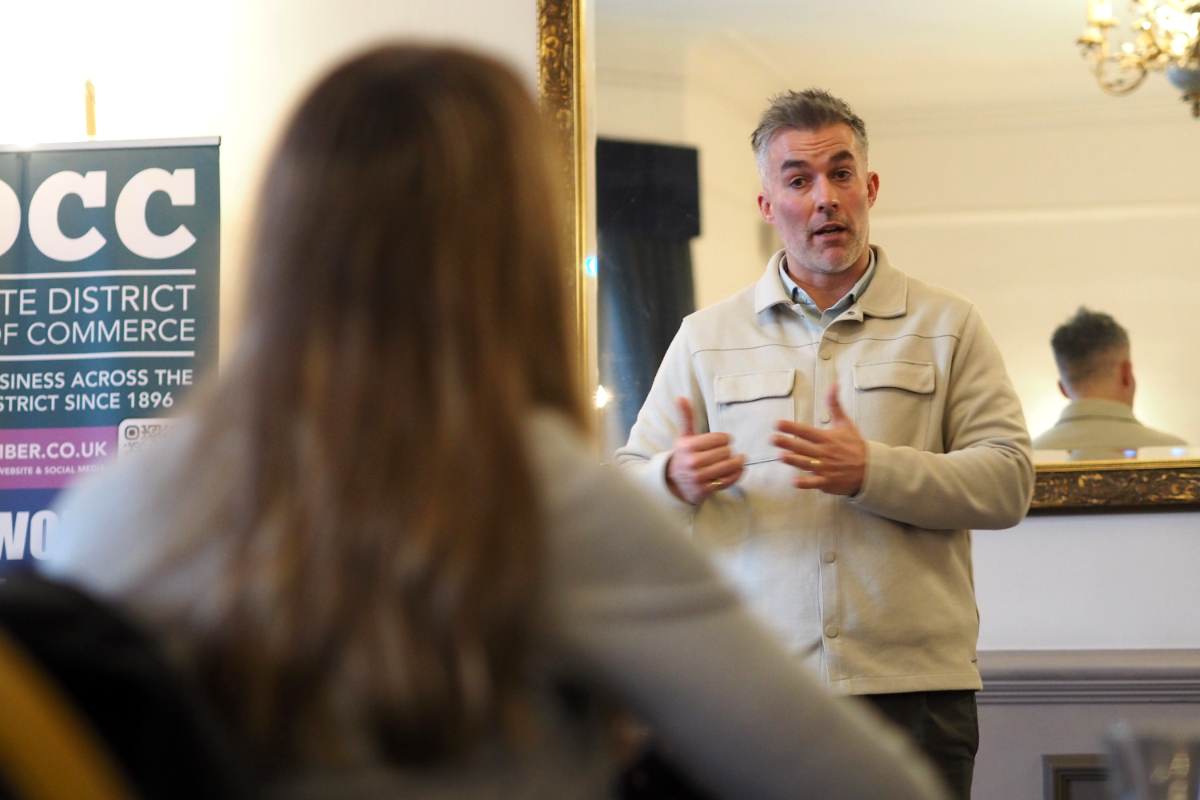


A wargame that tested how real-life local authorities, the emergency services and the military might respond to an attack on the UK has revealed a genuine appetite across the country for this kind of worst-case scenario training.
Dozens of people who work in the public sector as well as those representing banks and utilities gathered at Bath University for two days in the summer to take part in the simulation.
Sky News was given exclusive access to the event, dubbed Exercise Grapple, which was not organised by any government department. A video of what unfolded can be seen on Defence Insider, the new Sky News app.
Split into groups representing a national cell, a local resilience forum and various more localised groupings, participants were confronted with a series of crises, starting with sabotage and cyber hostilities and ending with a barrage of drones and missiles.
The wargame - run by a small, new, non-governmental entity called the National Civil Protection Centre - found that existing emergency structures worked fairly well even when used in response to war, but that a lot more coordination, integration and resilience is needed.
In a report on the simulation, the organisers concluded: "The most significant finding is not that the existing system requires wholesale replacement. Rather, Grapple demonstrates that the existing resilience architecture provides a substantial foundation upon which a more integrated Home Defence capability can be developed."
The wargame was described as one of the first multi-agency home defence exercises that have been held in the UK in decades.
It was based on a modern adaptation of actual home defence training that local government officials received during the Cold War when the whole country was much more aware of the steps everyone would need to take to transition from peace to war.
That costly system of plans and preparedness was shelved after the Soviet Union collapsed.
Since then, local authorities do still plan for emergencies but they typically focus on more routine hazards such as floods and power cuts as well as - more recently - pandemics.
That is changing though, with the Cabinet Office - which has overall responsibility for home defence - announcing in July that it will run a new home defence exercise next year.
The Grapple wargame offered a sense of how current emergency teams and personnel might cope at a time of war.
Sky News watched as the national cell drew on information from public services as well as the private sector in an effort to ensure the country could continue to function in some form.
The same kind of determination also emerged in a separate room that was simulating an imaginary council as well as a third area that was pretending to be a local parish, with all participants forced to do the best they could with limited resources, even though dealing with the impact of an act of war was a scenario they largely had not trained for.
The wargame organisers in their report, which is due to be published on Monday, said: "The principal opportunity is to strengthen the connections between strategic coordination, tactical operations, local government, community capability, critical infrastructure and the voluntary sector.
"Particular attention should be given to the ability to operate when conventional assumptions no longer hold."
The importance of the relationship between army liaison officers and the local authorities became clear as the crisis worsened.
Read more from Sky News:
The sole UK flight that flew over burning Twin Towers
Video shows drone strike near Boris Johnson's train
In a wartime scenario, the military would be turning to the civil authorities for assistance in a reversal of what often happens in the wake of a natural disaster, with the military helping local communities under what is known as military aid to the civil authorities (MACA).
Nick Gould, a founding member of the National Civil Protection Centre, helped to deliver the Bath University simulation, drawing on training on emergency war planning that he once received when he briefly worked in local government back in the late 1980s.
Mr Gould, an enthusiastic advocate for rebuilding national resilience, said the main lesson from the exercise is that "home defence is not the responsibility of one organisation. It is a national capability created by connecting the capabilities that already exist".

(c) Sky News 2026: Inside wargame that tests the UK's home defence

 Goal that led to Man Utd's derby defeat by City was VAR 'error', referees admit
 Deep-fried food banned and desserts cut back under new school dinner rules
 Sweden election: Preliminary results show one-seat advantage for left-wing bloc
 Mohamed al Fayed compensation claims could total £150m, law firm says
 Boris Johnson narrowly escapes drone attack - as Russia accused of 'escalation'
 Andy Burnham's high stakes policy headache that could split Labour MPs
 Police release images of six men after anti-migrant protest in Portsmouth