

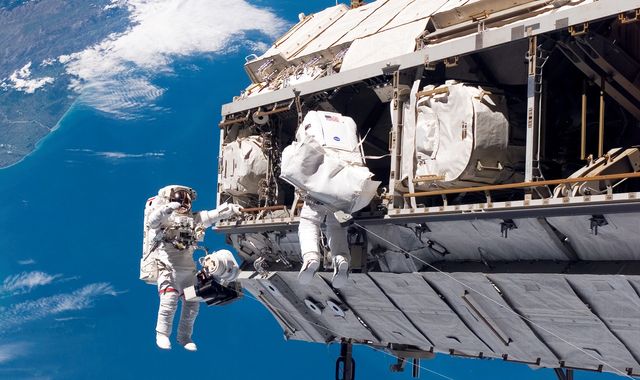
New research into the health effects of spaceflight has shown astronauts' brains change position and shape over time.
Following spaceflight, the brain shifts "upward and backward within the skull", with sensory and motor regions showing the largest shifts, the study found.
"There are also regional, nonlinear lateral deformations that differ between the superior and inferior portions of the brain," the research, published on Monday in the journal Proceedings of the National Academy of Sciences, reported.
The researchers looked at MRI scans from 26 astronauts prior and after their time in space.
It then compared the results with the scans of 24 civilian participants on Earth who were placed in a "long-duration head-down tilt bed rest".
Scientists found similar changes to the brains' shape and positions in the civilian participants, but the astronauts' brains exhibited greater upward shift.
"The health and human performance implications of these spaceflight-associated brain displacements and deformations require further study to pave the way for safer human space exploration," the study said, adding: "Although most of the brain deformation recovered over six months post-flight, some persisted."
Rachael Seidler, a professor in the department of applied physiology and kinesiology at the University of Florida and a co-author of the study, told Sky News' US partner network NBC: "We need to understand these changes and their impacts to keep astronauts safe and healthy and protect their longevity."
Read more from Sky News:
NASA mega-rocket for moon mission could launch in weeks
The 40 jobs 'most at risk' from AI - and 40 it can't touch
Speaking of how the amount of time spent in space also appeared to have an impact on the brain, Professor Seidler said: "The people who went for a year showed the largest changes.
"There were still some changes evident in people who went for two weeks, but duration seems to be the driving factor."

(c) Sky News 2026: New study finds astronauts' brains change after space travel

 UK 'won't back down' in row with Elon Musk's X over Grok sex images, says PM
 2025 was planet's third hottest year on record
 Wind power prices up in new offshore contracts as UK moves away from gas
 Grok controversy: Everything you need to know about X's sexual AI image scandal