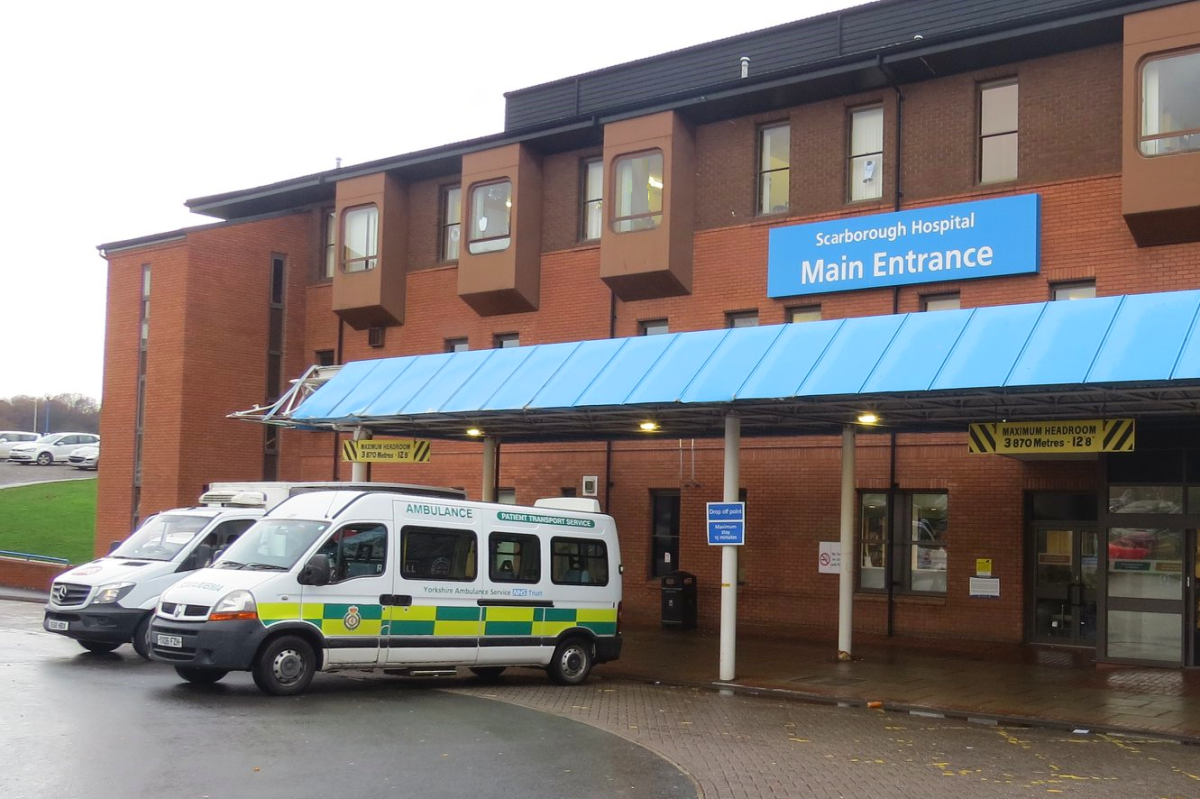



As Britons face a record-breaking heatwave, climatologists are predicting that these temperatures could become the new normal for summer over the next few decades.
The Sky News Data x Forensics team looked at Met Office data projecting how temperatures could increase due to global warming to find out which areas will be worst affected.
Zoom in, move around, and tap/click on your neighbourhood in our interactive map to see what the Met Office predicts for your local area:
The Met Office's data forecasts what the typical maximum temperature experienced across all summers could become.
Overall, the south, south east, and east of England - which are already the warmest areas of the country - are expected to see the largest rises in temperature.
These predicted temperatures are provided by the Met Office for a range of possible global warming scenarios.
Each of these scenarios is measured as an increase in degrees Celsius above pre-industrial levels, which are taken as the average temperature across 1850 to 1900.
When could we see new summer highs?
Assuming current emissions levels, global average temperatures are on track to increase by 2C above pre-industrial levels by roughly 2050, according to the UN's Intergovernmental Panel on Climate Change (IPCC).
Under this 2C global warming scenario, some of England's hottest areas, such as Hillingdon, Cheltenham, Cambridge, and Peterborough, are predicted by the Met Office to see new typical summer highs exceeding 36C.
Meanwhile Glasgow, Scotland's hottest city, sees current maximum summer temperatures of about 28C. This could rise to around 30C-31C.
The IPCC also estimates that global average temperature could reach 4C by the 2080s if greenhouse gas emissions are allowed to double from current levels within the next 25 years.
Should this happen, the hottest areas in England could see summer temperatures regularly hitting 40C, while Glasgow could soar above 33C.
What would be the impact of more frequent heatwaves?
Although a rise of just a few degrees may not seem that concerning day-to-day, a slightly higher temperature on average could have serious impacts, said Professor Nigel Arnell, an expert in meteorology at the University of Reading.
"Everything being of the order of two to three degrees warmer would be, most of the time, not necessarily particularly noticeable," said Prof Arnell. "But, during the heatwaves, it would. Because the sort of heatwaves that we are used to will become way more frequent."
Exposure to extreme heat can cause a host of health issues, especially in vulnerable populations such as infants and already-ill individuals.
"They [heatwaves] have all sorts of impacts on health - which we're familiar with - and the longer and more extreme they are, then those impacts begin to affect the general population, not just those particular categories with particular conditions," he added.
Earlier this month, the national medical director for the NHS, Professor Francesca Swords, pointed to increased demand on A&E and other hospital services due to May's heatwave.
"A&E staff bore the brunt of the heatwave in May, as the hot weather took its toll on the public," she said in an NHS statement.
In addition to health impacts, extreme heat can have severe impacts on infrastructure not built for high temperatures.
In the UK, this could encompass essential infrastructure systems such as the railway network, data centres, and the electricity grid.
National Rail recommends that passengers only travel "if absolutely necessary" on 24 and 25 June due to the risk of extreme heat affecting rails and power lines.
What can be done to prevent more frequent heatwaves?
Ultimately, Prof Arnell said the UK - and especially its leaders - need to start taking the threat of higher temperatures and more frequent heatwaves more seriously.
Infrastructure upgrades could be one way to make the UK more resilient to heatwaves, he said.
While he acknowledged that working to reduce greenhouse gas emissions will do little to impact heatwaves in the short term, he said it was essential in the long term.
"It's so easy to say, no, we'll worry about [reducing emissions] later. We'll worry about the cost-of-living crisis now. We'll kick that into the long grass. But it makes it way worse later on," he said.
Additional reporting by Daniel Dunford, data journalist

(c) Sky News 2026: Heatwave temperatures set to become the new normal in many UK regions – is yours one of them?

 Australia's highest-paid TV presenter faces backlash over Tommy Robinson interview
 Teenage boy found not guilty of killing nine-year-old Aria Thorpe
 Ed Miliband should be Andy Burnham's chancellor, says Harriet Harman
 Eight bodies found in state of 'advanced deterioration' at NHS trust
 Don't buy air conditioning until you've read this
 Woman killed and girl, 8, left in critical condition after train hits car in Lancashire
 Body found in river in search for missing 15-year-old boy in Devon
 Cost of living hope as oil prices return to pre-war levels
 Man killed his wife by stabbing her 78 times