


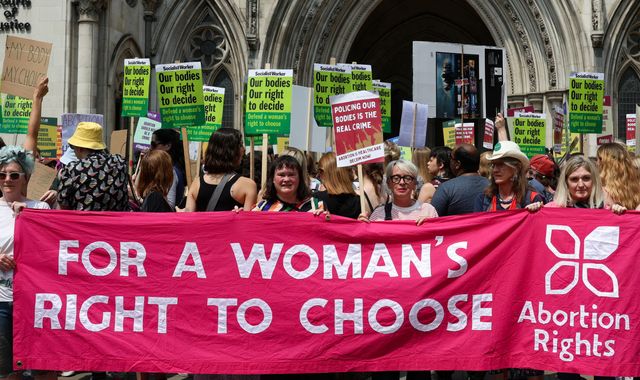
Women who were convicted or cautioned for illegal abortions will be automatically pardoned under a law change.
It means they are no longer criminally liable for ending their own pregnancies under section 241 of the Crime and Policing Act 2026 that came into force earlier this year.
Courts and police forces will today begin deleting details of convictions, cautions, arrests and investigations from criminal records.
The legal framework for access to an abortion in England and Wales, including the need for two doctors' signatures, will remain the same and anyone who acts outside the law will still face the threat of prosecution - including doctors.
Labour MP Tonia Antoniazzi put forward the amendment to the Crime and Policing Bill last year, saying that many women had been harmed by the "Victorian laws".
"I hope they can now take a breath," she said in a post on X in April, when the Crime and Policing Act came into force.
"Generation after generation of women are now protected from the threat of criminal investigation for ending their own pregnancy and women convicted pardoned."
The pardons also apply to deceased women, under section 242 of the law change.
More from Sky News:
Accuser calls for age of consent change
Man dies after being struck by ambulance
Women are not required to apply for pardons or take any action.
Tonia Antoniazzi said the more than 100 women impacted by the old abortion law will likely feel "huge relief".
She said the old law had resulted in women being "treated as suspects, dragged from hospital beds to police cells" and that they had been "met with interrogation and suspicion in moments of crisis where they should have been met with care, and dragged into the criminal justice system".
Abortion in England and Wales is legal when carried out by an authorised provider up to 24 weeks, and in very limited circumstances beyond this point, such as when the mother’s life is at risk or the child would be born with a severe disability.
It is also legal to take prescribed medication at home to terminate a pregnancy if a woman is less than 10 weeks pregnant.
Efforts to change the law to protect women from prosecution followed repeated calls from campaigners to repeal sections of the 19th-century law - the 1861 Offences Against the Person Act - after abortion was decriminalised in Northern Ireland in 2019.
Heidi Stewart, chief executive of the British Pregnancy Advisory Service (BPAS), said the change to the law acknowledges the "profound harm caused by their criminalisation".
"For too long, women have faced the devastating consequences of outdated abortion laws - including police investigations, prosecutions and criminal convictions, often at moments of unimaginable vulnerability.
Last year, Nicola Packer was cleared by a jury after she took medication at home at around 26 weeks pregnant during a Covid lockdown.
Ms Packer said she did not realise she had been pregnant for more than the legal 10-week limit for at-home abortion pills.
Royal College of Obstetricians and Gynaecologists president Dr Alison Wright said the pardons "recognise the injustice of historical convictions and mean women no longer have to live with the consequences of a criminal record for something that should never have been treated as a crime".

(c) Sky News 2026: British women convicted of illegal abortions under Victorian-era law to receive automatic pa

 PM to say 'Brexit hasn't worked' and set out conditions for future EU deal in major speech
 Snow warning in place for large part of the UK with travel disruption risk
 Government accused of 'complacency' over 'catastrophic' security risks to UK
 AI-generated child sex abuse images 'soar 8,400% in two years', study finds
 Man charged with causing death by dangerous driving after two killed in police chase collision
 England hang on to beat world champions Spain 3-2 in Madrid thriller