

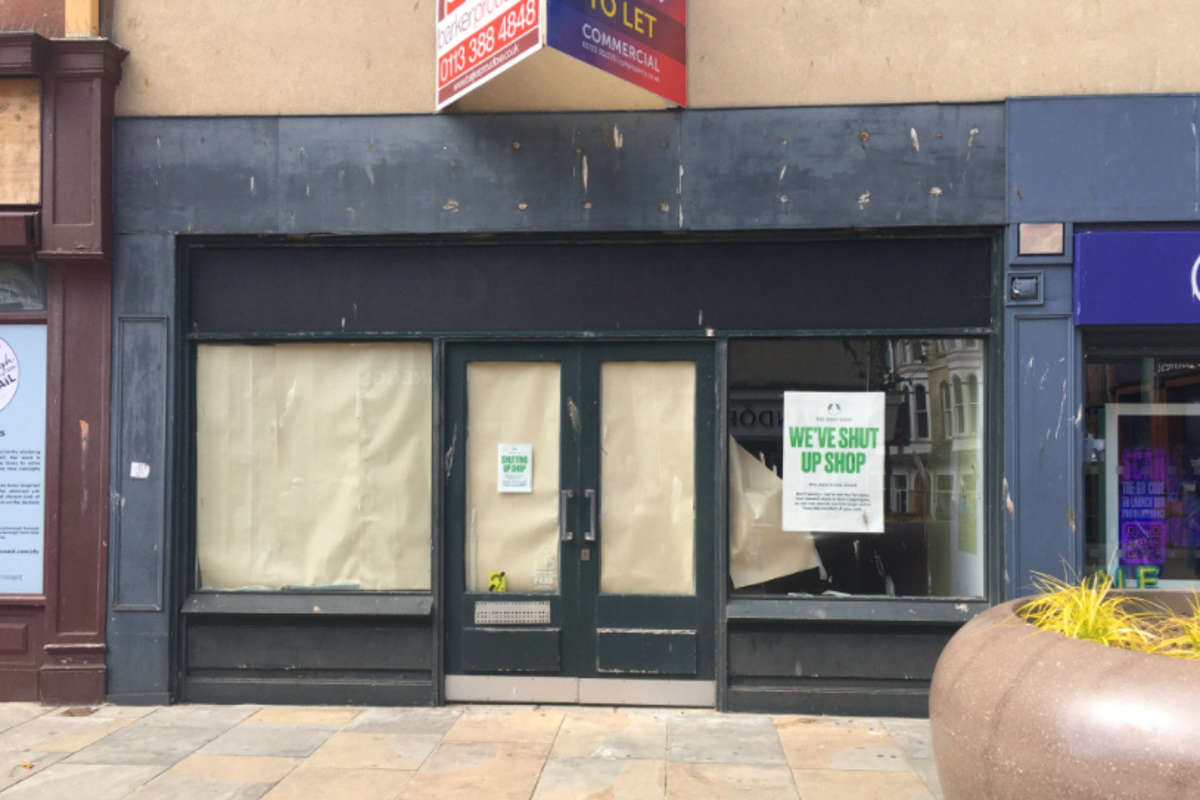
The number of empty shops in Scarborough is 5% above the national average but councillors are optimistic for the future.
The traditional British high street is undergoing a period of profound transformation, and the coastal town of Scarborough finds itself at the heart of the changes. As shoppers increasingly turn to online giants, local authorities are exploring innovative ways to breathe new life into empty shop units and adapt to a changing economic climate.
Recent data from North Yorkshire Council highlights a complex picture for the town's commercial health. While the national average vacancy rate (the number of empty shops) in Great Britain stands at 13.4%, Scarborough’s figures require a closer look to understand the underlying trends.
Official reports indicate that the town centre’s vacancy rate is currently influenced heavily by the ongoing redevelopment of the Brunswick Centre. Without the impact of the Brunswick, North Yorkshire Council say that the high street vacancy rate has actually shown signs of improvement, falling from 18.9% in 2024 to 15.8% in 2025, although the figure with the Brunswick included shows a more modest reduction at 18.6%.
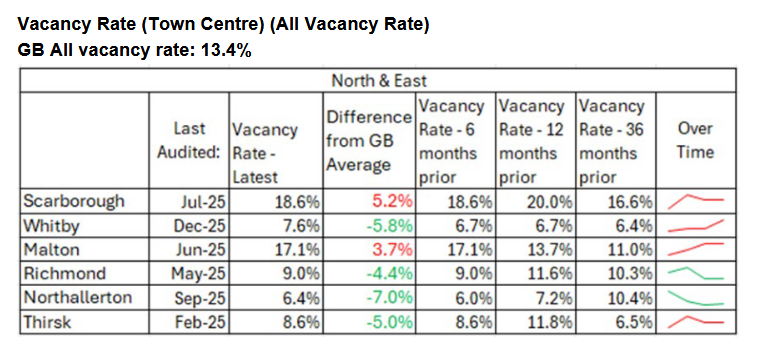
The town centre vacancy rate in Scarborough is almost two and a half times that of Whitby and York.
Scarborough has the highest town centre vacancy rate in the county at 18.6 per cent, followed by Malton at 17.1 per cent, and Ripon at 12.8 per cent, while Whitby has a vacancy rate of just 7.6 per cent.
The national high street vacancy rate across the UK stood at 13.8 per cent at the end of the fourth quarter of 2024, Savills reported.
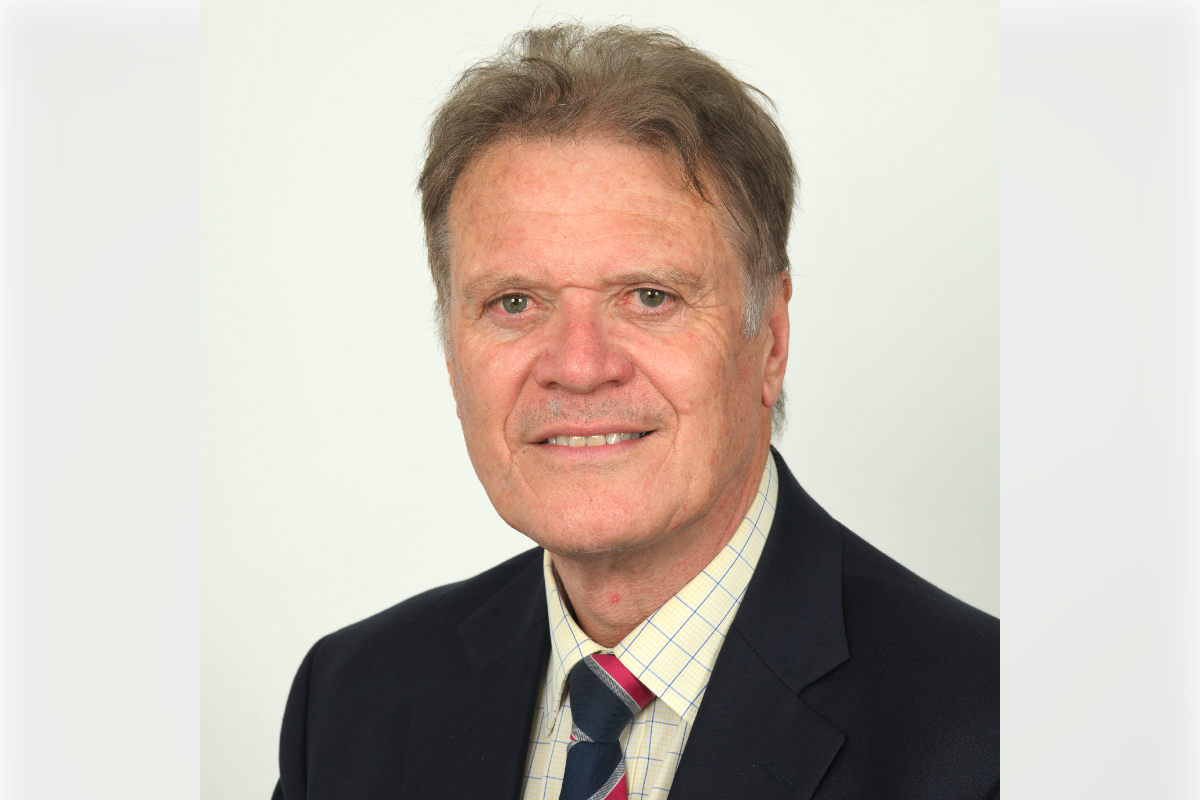
Councillor Mark Crane, North Yorkshire Council’s Executive Member for Business, provided insight into the current statistics and the impact of major projects:
"We've recently done a piece of work to look at the vacancy rates in Scarborough, Malton and and indeed across most of the county and the perhaps surprising news is that in Scarborough and Malton they are in line with the national average and in some of our towns they're below the national average.
That said the national average is still higher than we would like it to be and I have to say that the Scarborough figure excludes the Brunswick which is being redeveloped. If if you put Brunswick back in the figures would be worse, but that's closed and we're hoping it'll be redeveloped and will be a significant boost for Scarborough."
The rise of e-commerce has fundamentally altered what residents expect from their town centres. According to Councillor Crane, the era of the high street being solely a retail hub is coming to an end, giving way to a more social atmosphere. He noted:
"Going forward high streets will not be what we have known whilst growing up. We have seen massive increase in the likes of Amazon etc which has clearly had an impact on high streets and more and more of becoming places of cafes and places for people to meet."
To address the "genuine challenge" of non-high street vacancies, which are numerous in areas away from the main shopping thoroughfares, the council is looking at diverse solutions. One significant opportunity identified by council officers is the potential to convert these peripheral commercial properties into much-needed housing, helping to increase the number of dwellings within the town.
The council says it is pro-actively seeking to support new entrepreneurs and revitalise dormant spaces through direct intervention and community partnership. Councillor Crane outlined the authority’s ambitions to act as a catalyst for growth:
"One of the things that we are looking at is whether we can get a hold of some property and make it available for people who want to start up business. It's something that we are looking at and would like to do and we've got another plan for Scarborough where we'd like to do some work with the owners of those shops.
I think it's something that we can do more on and we would like to work with both the community and the owners of those properties to get some of those properties back into life and make Scarborough and Morton and other places more thriving communities."
At a public meeting of the United Scarborough residents’ group on Monday (February 16) concerns were raised about the high number of empty town centre businesses.
Several residents said that while large chains were moving out of town centres, business rates were often “far too expensive for independent local businesses”, and also noted the “excessive number of e-cigarette and gambling shops”.
Embracing a café culture was supported by many of those in attendance, with one resident noting that “we have a better variety of cafés than York”.

 East Riding Councillor: Why Are Our Children Worth Less Than Everyone Else's?
 Mud Rescue Drama in Whitby Harbour
 £44,000 Funding Boost to Help Coastal Communities Feel More Connected and Supported
 Maximum Tax Increase for Humberside Fire Authority Leaves it £3.5m Short
 £150,000 Funding to Reduce Winter Deaths in North Yorkshire
 North Yorkshire Council Approves £150,000 Financial Support for Scarborough Athletic Football Club
 Yorkshire Coast Awaits Next Steps as National Visitor Levy Consultation Concludes
 Council Update on Operation of Scarborough's Alpamare Water Park
 Whitby Town New Managers Beaten On Debut After Last Gasp Killer Blow
 Bridlington Town Bounce Back Continues
 Local Residents Launch Campaign Against Proposed Wind Farm at Woldgate
 Solar Carports to be Installed Across East Riding Leisure Centres










Comments
Add a comment