


A judicial review is set to be launched against the government's decision to approve a new Chinese "super embassy" in central London.
The controversial diplomatic base had been opposed for various reasons, including the possibility it would be used as an espionage base, the risk that nearby sensitive financial cabling could be intercepted, and the potential of protests against China being held outside.
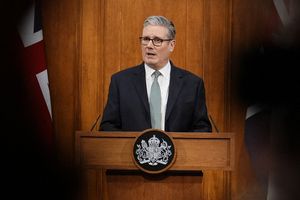
However, Sir Keir Starmer's government has given the site, at Royal Mint Court near the Tower of London, planning permission following three delays.
It paves the way for the Labour leader to become the first British prime minister to visit China since Baroness Theresa May in 2018, with a trip on the cards before the end of this month.
Sky News understands Sir Keir's visit was conditional on the embassy, which will be the largest in Europe, being approved.
The decision was met with derision by campaigners, local residents and other political parties over national security concerns.
Judicial review to be launched
The residents of Royal Mint Court, whose landlord is China after it bought the site in 2018, are set to launch a judicial review against the decision. They have been raising funds for months in case the application was approved.
They will argue that they were taken out of the planning process when it was "called in" by the Labour government weeks after they won the election in 2024. It had previously been denied by Tower Hamlets Council.
Their review will be based on concerns they will be ousted from their homes by the Chinese government and over security, safety and privacy worries.
Mark Nygate, treasurer of the Royal Mint Residents' Association, said: "The residents are determined to keep fighting today's decision.
"Along with our diaspora partners, we have reached out worldwide with our story, and highlighted the issues and earlier legal opinions that will be the basis for our challenge."
National security concerns
China's planning application had redacted most of the basement "for security reasons", which prompted large-scale protests over fears rooms might be used to detain dissidents.
The plans were then uncovered by The Telegraph, revealing a 208-room underground complex, with one of the secret basements running metres from cables transmitting sensitive financial data between the capital's two financial centres, Canary Wharf and the City of London.
A letter sent by Sir Ken McCallum, director general of MI5, and Anne Keast-Butler, director of GCHQ, to the home and foreign secretaries moments before the decision said they had worked closely with the government throughout the planning application process and noted MI5 has "over 100 years of experience managing national security risks associated with foreign diplomatic premises in London".
They said for any foreign embassy, "it is not realistic to expect to be able wholly to eliminate each and every potential risk" but they have created a "package of mitigations" to deal with sensitive national security issues, including cabling.
Consolidating China's current seven diplomatic sites across London "should bring clear security advantages", they added.
A government spokesperson said the planning decision was taken independently by Steve Reed, the housing secretary, after then-foreign secretary Boris Johnson "provided formal diplomatic consent for the site".
"More broadly, countries establishing embassies in other countries' capitals is a normal part of international relations, they said.
"National security is our first duty. Intelligence agencies have been involved throughout the process and an extensive range of measures have been developed to manage any risks.
"Following extensive negotiations in recent months, the Chinese Government has agreed to consolidate its seven current sites in London into one site, bringing clear security advantages."
Officials last week said an undisclosed "note verbale" - a private diplomatic communication between governments - said the diplomatic consent was conditional on the embassy obtaining planning permission, but that has not been published.
Ministers 'hiding behind planning procedure'
Conservative shadow security minister Alicia Kearns, a long-time Beijing critic, said ministers could not hide behind the planning process as she accused the government of having "gifted the Chinese Communist Party (CCP) a launchpad for economic warfare in the heart of London".
"It was clear approval was inevitable since Starmer promised to assist Xi Jinping in a phone call in August 2024," she said.
"Ministers must own their decision and all future consequences. They can no longer hide behind planning procedure. Questions must be answered, starting with mitigations.
"Will the Chinese pay for critical cabling to be moved? Will there be any monitoring of the site against transnational repression and hacking?
"There is no commitment ministers can give that they will be able to mitigate CPC technological advancements in years to come. Expect this decision to go to judicial review."
'Astonishing and appalling' decision
Mark Sabah, UK director of the Committee for Freedom in Hong Kong Foundation, said the decision is "astonishing and appalling", given warnings from British and foreign politicians, Five Eyes allies, opposition groups, local residents, MI5 and MI6, and the police.
"The risks to Britain's national security are clear to everyone, except it seems to Keir Starmer and the government he leads," he said.
"Questions need to be raised about why, despite every possible warning, these plans have continued to be pushed ahead regardless.
"We stand firm in our belief that while China is entitled to an embassy, this particular site, with its historic significance, redacted floor plans, underground chambers and proximity to sensitive data cables, and all the risks that these entail, is the wrong decision for Britain's national security and for British citizens."
A group of politicians from around the world, aimed at addressing China's influence, warned granting approval is the "wrong decision for the UK".
Luke de Pulford, director of the Inter-Parliamentary Alliance on China (IPAC), said: "This is the wrong decision for the UK, sending all the wrong signals. Wrong for dissidents, wrong for UK national security.
"Our three Cs China policy is less complete, challenge and cooperate, more cover-up, cave in, and cash out."

(c) Sky News 2026: Judicial review to be launched after China's 'super embassy' in London approved

 What we know so far about the fatal train crash in Spain
 Trump's extraordinary letter to Norway about Greenland - in full and fact-checked
 Everything we know about China's new 'super embassy'
 Greenland latest: Starmer was the gravest I've ever seen him as scale of NATO crisis becomes clear
 Doctors warn of 'horrific' impact of tech and devices on children and young people's health
 What it's like to live next to a 25,000-tonne illegal waste dump - with rats everywhere