

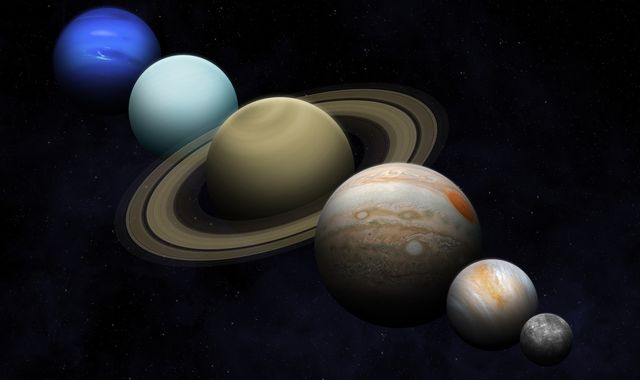
Not one, not two, but six planets are due to line up in the night skies this weekend in a relatively rare planetary parade.
The phenomenon will see Mercury, Venus, Saturn, Jupiter, Uranus and Neptune align, with some of the planets visible to the naked eye.
This will mean a potential of six planets on display at once, the Greenwich Royal Observatory says.
Here is everything you need to know ahead of the phenomenon and how to maximise your chances of spotting all six planets.
When will planets be visible?
After sunset on Saturday 28 February and Sunday 1 March, Mercury, Venus, Jupiter and Saturn will be visible to the naked eye to people across the globe, if clear skies allow.
The Royal Observatory says Uranus and Neptune will only be spotted with binoculars and telescopes.
Mercury, Venus, Saturn and Neptune will be visible in the west very close to the horizon, making sunlight and anything on your skyline additional obstacles to spotting these planets.
Jupiter will be highest planet in the sky for most of the night and, according to the Royal Observatory, will be the easiest of the six to find. Even in light-polluted areas it will be a bright point of light visible to the naked eye.
For people in the UK, Sunday will be the best day to spot the planets, according to astronomy website Star Walk.
It states 6.10pm in London and 6.16pm in Manchester are expected to be the best times to look up to the skies.
How do you know you've seen a planet?
At least one bright planet will be visible on most nights, according to NASA.
Planetary scientist Sara Mazrouei with Humber Polytechnic in Canada, said to remember this simple tip: "If it is twinkling, it's a star. If it is not twinkling, it's a planet."
Why do the planets align?
In simple terms, as the planets in our Solar System orbit the sun, they occasionally line up in space, according to NASA.
The term planetary alignment can refer to apparent line-ups with other planets, the moon, or bright stars.
When this happens, the planets always appear along a line or an arc, NASA adds, due to the way they are viewed from Earth.
In reality the planets aren't in a straight line, but are close together on one side of the sun.
How rare is it?
"Planetary alignments, where multiple planets appear close together in the sky, occur periodically but are relatively rare," Dr Shyam Balaji, researcher in astroparticle physics and cosmology at King's College London, previously told Sky News.
He added alignments of six or more planets happen approximately every few decades.
NASA adds Jupiter and Saturn are frequently seen in the night sky, but the addition of Venus and Mercury are particularly noteworthy.
Will UK skies be clear enough to see the planets?
There's good news, and somewhat bad news - depending on where you are in the UK.
On Saturday night England and Wales are expected to have clearier skies before cloudier conditions start increase from the north and west.
While on Sunday night showery rain will spread to the east, becoming heavy in the northwest. Meaning clearier skies will be more likely in southern England.
Read more from Sky News:
Vegetarian diet can slash risk of five cancers
NASA reveals details of medical incident
Other top tips for planet-spotters
To help keen observers maximise their chances of seeing as many planets as possible, Dr Balaji, from King's College London recommends the following tips:
• Find a location away from city lights
• Use current astronomical software or websites to find a planet's latest position
• Exercise caution when observing near sunrise or sunset
• Check reliable astronomy websites for updated viewing information as the date approaches.

(c) Sky News 2026: Planetary parade: How and when to spot six planets in UK skies in rare alignment

 Green's stunning by-election win proves Polanski surge is real - but what now for Starmer?
 At least 15 killed after military plane crashes on to busy road in Bolivia
 'I had never seen tanks before' - stories from Ukraine's children living through war
 Trump's furious response to Anthropic is as much about power as it is about AI safety
 Tram derailment leaves two dead and dozens injured
 Paramount strikes deal to buy Warner Bros Discovery for $110bn
 Neil Sedaka, singer of Breaking Up Is Hard To Do and Laughter In The Rain, has died
 UK issues travel warning as Middle East crisis worsens