
South Yorkshire Police (SYP) "consistently and intentionally presented unsubstantiated evidence" about the Hillsborough disaster, investigators say.
The Independent Office for Police Conduct (IOPC) has been probing the 1989 tragedy since 2012 under the title Operation Resolve, and today published its verdict in a new 366-page report.
Dozens of allegations of misconduct against several officers have been upheld, but none will face disciplinary proceedings because they all left the police service before investigations began, the IOPC said.
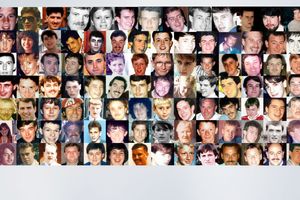
The disaster that unfolded at Hillsborough stadium in Sheffield in April 1989 caused the deaths of 97 people, with 766 more injured.
On the day, a large crowd of fans had formed, waiting to gain access through a single entrance on Leppings Lane. Police opened a gate to admit the crowd, leading to a deadly crush inside.
The IOPC investigation aimed to increase understanding of the disaster in relation to the actions of police forces involved. Here are its key findings.
The safety of the stadium
The report found that the safe capacity of the stand where the tragedy unfolded "was based on incorrect calculations".
An engineering expert, looking at the safety standards of 1989, said the West Terrace should have had a capacity of no more than 4,518 - perhaps as low as 3,089 - but instead its permitted capacity was 7,200.
This larger calculation, from 1979, wasn't revisited even when changes were made that left less space for fans.
And while police had recommended changes to the Leppings Lane entrance to the stadium, these changes were not made, being rejected as "too expensive".
On Leppings Lane, there were only seven turnstiles to serve 10,100 Liverpool fans with standing tickets (each turnstile could admit a maximum of 750 people per hour).
It was not clear, the report's authors wrote, that police understood "the potential consequences" of this.
The horror unfolds
Supporters reported the pressure from the back of the terrace "suddenly intensified" at around 2.55pm, five minutes before kick off and minutes after Gate C had been opened.
The report describes what happened next.
At 2.57pm, the gate to pen 3 in the perimeter fence burst open, and the officer there tried to close it, thinking it was a pitch invasion.
As the scale of the disaster became clear, the police control box called for a "fleet of ambulances" to be dispatched.
But they offered "limited information" about the incident, so the request was rejected, with only a "limited initial response" deployed instead.
When the ambulances did arrive, police outside the stadium did not know why they had been called or where they were needed.
The IOPC concluded that, "with no central organisation of the rescue effort... it was left to those on the pitch to make decisions as best they could".
All told, the lack of direction "meant that medical resources were not well deployed".
But the report found no evidence of police using their truncheons on supporters or physically preventing fans from escaping the pens.
Police planning
Police argued that their planning for the fateful day was broadly the same as it had been for another game between the same teams a year earlier.
But the IOPC found that actually there was a 14% reduction in the number of officers on duty, and 21% fewer in the area where Liverpool fans were expected to arrive.
Several arriving fans commented that there was a lack of control compared to the previous year's game, the report said.
Nor was there contingency planning for crushes on the West Terrace, which had occurred before.
Furthermore, the authors wrote, the three police divisions deployed to the game were not co-ordinating with each other.
A 'poorly timed' decision
The report said SYP had made a "poorly timed" decision to replace its previous "highly experienced match commander".
In his place would be chief superintendent David Duckenfield, "who had never previously commanded a match" at the stadium.
And while the officers present noticed that the areas for Nottingham Forest fans were much fuller than those for Liverpool fans, none reported their concerns to Duckenfield.
Read more:
'Momentous' step as Hillsborough Law introduced
Explained: The Hillsborough Law and what happens next
Duckenfield, referring to a "very limited set of pre-determined criteria" chose not to delay kick-off and did not consider turnstile count data as part of his decision-making process.
However, while he made the decision to open the exit gates to arriving fans, he was not blamed for the "prolonged, uncontrolled opening" of Gate C, because it had already been opened at that point without him being told.
In fact, the authors wrote, the decision to open Gate C wasn't communicated to anybody in the stadium, with "catastrophic consequences".
As a result, police didn't guide supporters in, and they headed in large numbers towards the already-crowded centre pens of the terrace.
Duckenfield was cleared of gross negligence manslaughter for the deaths of the 97 fans in 2019, after two trials.
Getting the story straight
After the disaster, 327 officers were asked to produce written accounts of the day, including sharing their "fears, feelings and observations" and commenting on "the mood of the fans".
A number of officers have previously said their accounts were amended without their agreement, and the IOPC found some were uncomfortable with the changes and were pressured to accept the amended version.
The new report also states that the number of accounts that were amended is more than 100 higher than previously thought. Amendments ranged from being relatively minor, such as correcting spelling, to several paragraphs being removed or rewritten.
A previous allegation, made in a report by the Hillsborough Independent Panel (HIP) in 2012, claimed SYP officers were instructed not to write about their actions on the day in pocket notebooks "in contrast to professional training".
But the IOPC claims it obtained more than 8,000 pocket notebooks from relevant periods, 359 of which were found to include entries related to the disaster, meaning there is conflicting evidence regarding the allegation.
The new report also found no evidence that supporters' behaviour caused "or in any way contributed" to the disaster.
And though police suggested at the time that there was an "unprecedented level of alcohol consumption" at the game, the report found that most third-party accounts, as well as images and video, did not support the claim.
Nonetheless, the authors said, "some of the earliest" evidence collected by police seemed to be focused on alcohol consumption, with officers taking photos of bins and collecting rubbish nearby.
But the decision to check the blood alcohol level of the deceased was not influenced by the police, the evidence showed; it was the decision of coroner Dr Stefan Popper.
Another claim that supporters had burned a police horse with cigarettes was debunked as "not only improbable, but implausible".
Irvine Patnick, then Conservative MP for Sheffield Hallam, was identified as the source of stories which painted the supporters in a negative light, having repeated accounts he'd heard from police officers.
The families of the dead
Police treated the deceased in a way that "lacked compassion" and were "unnecessarily rigid", the report found.
It was found that Dr Popper insisted that those coming to identify the dead be shown photos of the bodies, even when documents found on the deceased might have spared them this.
Some families said they were not allowed to touch their loved ones, the report said, with police on one occasion saying the bodies were "property of the coroner".
Many said they were asked by police about their loved ones' consumption of alcohol, or whether they'd had a ticket for the game.
Investigating the investigators
In August 1989, West Midlands Police (WMP) were asked to investigate the conduct of their sister force and undertake a police disciplinary investigation into complaints that had been made against SYP officers.
How they carried out this investigation is examined in the IOPC report.
It states that when WMP officers were alerted to SYP accounts of the disaster being amended, "they did not take action" to prevent it.
Many supporters described being extensively quizzed about alcohol by WMP, the authors wrote.
And though "very few comments" about alcohol were found in the statements collected, the investigators nonetheless "appear to have reached a view that alcohol was a key factor in the disaster".
WMP also ran criminal records checks on 94 of those who died, the report said. Twenty-two victims had been under the age of 18, with the youngest 10 years old.
The IOPC did say that the force "for the most part" interviewed witnesses "professionally", and that it adhered to "the professional standards of the time" when investigating complaints.
But it ultimately made several criticisms of WMP, including failing to approach key witnesses and failing to gather its own statements from SYP officers.
Shifting the blame
In its damning final section, the report found SYP had attempted to deflect blame from the disaster away from police, "based on the consistent patterns" in the force's actions.
It further found that SYP had consistently tried to find and promote evidence of drunken behaviour among fans.
The authors wrote: "SYP consistently and intentionally presented unsubstantiated evidence. It also altered the evidence of officers before it was submitted, by amending their accounts."
There was no evidence, however, that WMP had tried to deflect blame away from police, though their investigation was "flawed and narrow", and its officers had a "fixed view of the evidence before they started".
The police officers named in the report
The IOPC named 12 officers who would have had a case of gross misconduct to answer if they had still been with their respective forces.
CC Peter Wright, SYP, who faced six allegations, for:
• adopting a defensive approach in interacting with the Taylor Inquiry
• seeking to minimise SYP's culpability for the disaster and deflect blame towards Liverpool supporters through engagement with the media and MPs
ACC Walter Jackson, SYP, who faced two allegations, for:
• failing to plan adequately to prevent the disaster taking place
• failing to organise and direct junior-ranking police officers to help save lives
Supt David Duckenfield, SYP, who faced 10 allegations, for:
• failing to plan adequately to prevent the disaster
• failing to control a dangerous build-up of supporters
• failing to control the movement of supporters subsequent to the opening of Gate C
• failing to monitor crowd numbers in pens
• failing to act when it became obvious pens were too full, despite having an excellent viewpoint
• failing to respond to the developing tragedy and being slow to coordinate the rescue operation
• failing to act when people were in distress
• lying about his order to open Gate C, suggesting supporters had forced the gate
Supt Bernard Murray, SYP, who faced five allegations, for:
• failing to plan adequately in order to prevent the disaster
• failing to prevent a dangerous build-up of supporters outside the gates
• failing to control the movement of supporters following the opening of Gate C
• failing in the way he responded to events that unfolded in Pens 3 and 4
• failing to monitor crowd numbers in Pen 3 and 4
• failing to respond to the developing tragedy and being slow to coordinate the rescue operation
• failing to organise and direct junior-ranking police officers to save lives
Supt Roger Marshall, SYP, who faced two allegations, for:
• failing to take any steps to control the flow of supporters and manage the situation
• requesting gates be opened, giving supporters unlimited and uncontrolled access to the football ground
Ch Insp Norman Bettison, SYP, who faced two allegations, for:
• deliberate dishonesty about his involvement in the disaster during his application for and appointment to Chief Constable of Merseyside Police in 1998
• providing misleading and inaccurate press statements, minimising his role to one on the periphery of the post-disaster investigations carried out by SYP - including during his time as chief constable of both Merseyside and West Yorkshire Police
DCI Alan Foster, SYP, who faced one allegation, for:
• directly or indirectly bringing undue pressure to bear upon those SYP officers who refused to make alterations to their original accounts
Insp Harry White, SYP, who faced one allegation, for:
• failing in his supervisory duties and responsibility regarding the management of the build-up of the crowd on the inner concourse, and in his subsequent response to the unfolding situation
PS John Morgan, SYP, who faced two allegations, for:
• failing to supervise his serial at a key time prior to the match, because he was unnecessarily absent from his area of responsibility
• failing to take any action in response to the crowd coming through Gate C after the gate was opened at 2.48pm and 2.52pm
PC David Scott, SYP, who faced one allegation, for:
• lying about a police horse being burnt with cigarettes by Liverpool supporters
ACC Mervyn Jones, WMP, who faced two allegations, for:
• failing to investigate SYP effectively
• being biased against supporters in favour of SYP
Det Ch Supt Michael Foster, WMP, who faced six allegations, for:
• failing to investigate SYP effectively
• being biased against supporters in favour of SYP
Another officer, Supt Roger Greenwood of SYP, faced one allegation of misconduct, for:
• failing in the way he responded to events that unfolded in Pens 3 and 4
• failing to organise and direct junior-ranking police officers to help save lives

(c) Sky News 2025: Key findings from the police watchdog's Hillsborough report

 Hillsborough report finds police guilty of 'complacency, failure and concerted effort' to blame fans
 Sex offences against women not given same response as other high-priority crimes, inquiry after Sarah Everard murder finds
 More than 800,000 young children seeing social media content 'designed to hook adults', figures show
 PM issues China warning - and hits out at Brexit
 'Brave and dashing': Family's tribute to cricketer Robin Smith
 Is Starmer continuing to mislead public over the budget?
 Children's home providers putting profit ahead of need, warns Ofsted
 Thousands remain without water in Kent after 'chemical issue' - what you need to know
 Dame Joanna Lumley warns of 'crisis hidden in plain sight' - with 1.5 million older people set to spend Christmas alone